

Learning to read music is mainly about learning to quickly recognize notes on the staff fast enough that you don’t have to pause and decode them.
In this guide, you’ll learn a step-by-step way to read music after memorizing only a few Landmark Notes. (And if you’ve been using FACE / Every Good Boy Does Fine, you’ll learn how to move past them without starting over).
Like almost everyone, I learned to read music using Every Good Boy Does Fine and FACE. It worked. Sort of.
The mnemonics were easy to remember, but I still stumbled over notes when I played. I could never remember specific notes, especially D and B, and reading music felt more like solving a puzzle than actually making music.
Things changed when I finally memorized my first note without using the FACE trick. It was the E in FACE, the highest space on the staff.
I stopped having to go through FACE each time I saw that note. It became a Landmark. Once I knew E well, the notes next to it made sense. F was above E, and D was below. The notes started to connect rather than feeling random, and I could read much faster. Later, I learned a few more notes and used them as reference points for the rest.
Years later, I discovered this wasn’t a personal trick—it was the foundation of a better way to learn how to read notes. By choosing the right three landmark notes, you can read treble, bass, and alto clefs quickly, without slowing yourself down with *FACE* or *Every Good Boy Does Fine*.
After years of teaching, I’ve seen the same result over and over: these mnemonics help classrooms pass written exams, but they slow down reading progress for students who want to play music. Landmark Notes teach students to read music fluently.
This guide will show you how to use this approach.
Teaching a young child? Check out the Parent/Teacher Version: How to Teach Children to Read Music
Comparing Methods
How to Read Music Using FACE and Every Good Boy (And Why It Is Slow)
Lets look at the most common method used to teach music (FACE and Every Good Boy Does Fine) and see how much it slows down learning.
For those of you who aren't familiar with the FACE and Every Good Boy Does Fine method, teachers all over the world use these two memory aids to help their students memorize the names of the lines and spaces on the staff from bottom to top.
It's a quick and easy trick to memorize the note names, but let's see what happens when we try to use it to play a simple song: "Twinkle, Twinkle, Little Star."
I've traced the eye movements necessary to figure out the piece using different colors. Here's how this method ends up playing out in practice:
Only two steps, right? Here's how this method ends up playing out in practice:
- Figure out the first note is on a line
- Go to the bottom line
- Go through **EGBDF**; stop at the correct note.
- Next note: figure out if it is on a line or space (it's on a line; remember to use EBGDF and not FACE)
- Go to the bottom line, again
- Go up through **EGBDF**; stop at the correct note.
- Figure out the first note is on a line (now is that FACE or EBGDF?)
- Go to the bottom line again
- Work all the way up through the entire staff, *again*, using **FACE**
- Keep going, down and up and up and down and line or space, line or space, line or space, until you get to the end.
This method is suitable for teaching an entire classroom of middle schoolers to "read music" well enough to pass a test. But it's terrible at teaching students to recognize and decode musical patterns quickly.
Why Landmark Notes Are Fast
Let's compare it with the landmark note system. Once again, we'll use Twinkle Twinkle Little Star. This time, I'll show you how easy it is if you know the following things:
1. The Musical Alphabet
2. The Landmark Notes
3. The C major scale
In the example below, the red dots are Landmark notes. They're memorized.
Here are the steps to read the same passage of music as above using the Landmark Note method instead of the EGBDF method:
- This note is one of your memorized Landmark Notes, and there are two of them. Play it two times.
- Again, two Landmark Notes. They are memorized, so play them.
- This note goes up the scale one note. Go up the scale one tone and play that note.
- The next part goes down the scale, note by note, until you arrive back where you started. All you have to do is play down the scale.
Only four steps to read all the music in the first phrase of Twinkle Twinkle Little Star when using the Landmark Note Method. With the EGBDF method, four steps will only get you to the second note.
Learning to use the Landmark Note System starts with something you already know: the first seven notes of the alphabet.
I've used Twinkle in the key of G so as to avoid ledger lines and maximize clarity in this beginner's example. The ideal Landmark notes are in the key of C, so they won't line up exactly with the notes above.
Using The Alphabet to Learn To Read Music
Mastering Note Names in Motion
The first thing you need to do to make note reading easier is to be able to say the Musical Alphabet forwards and backwards, fast. The Musical Alphabet is made of the first seven letters of the English alphabet: A B C D E F G.
Reciting the Musical Alphabet forwards is simple enough: A B C D E F G. To master it backwards, repeat each line 5 times as fast as you can
- G F E
- G F E D
- G F E D C
- G F E D C B
- G F E D C B A
You need to know that the Musical Alphabet loops; after G comes A. When going backwards, after A comes G. I'll use a starting letter of C to show how this works in practice:
- Moving forwards: C D E F G A B
- Moving backwards: C B A G F E D
Make sure you practice saying the musical alphabet, starting on every letter.
If you're struggling to understand, use this letter-line. Find the letter you want to start on and read the letters until you return to your starting letter. Then repeat the exercise going backwards. Do this until the G A relationship is clear.
A B C D E F G A B C D E F G
You can confidently move to the next step when you can
- Repeat it 2 times in a row without pausing, forwards then backwards, starting on any letter.
- i.e., repeat this 2x C D E F G A B | C B A G F E D
You can challenge yourself by saying every other letter, forwards, then backwards: A C E G B D F | A F D B G E C A
Now that you've gotten comfortable with the Musical Alphabet, let's use it with your instrument.
Note Names While Playing
The following exercises will help you transfer your Musical Alphabet skills to your instrument and give you some easy exercises to prepare you to read notes. By the time you're done with this section, you'll be itching to dive into reading music.
For the next step, you'll need a C major scale. Any C major scale will help you with the material in this section; I'll be using a scale that starts on middle C for the examples in the rest of this article. You don't need to perform it perfectly or quickly; you just need to get through it comfortably. And if you don't know a C major scale, keep reading and come back to this section later. There's plenty of helpful info you can learn without a C major scale under your fingers right now.
By the time you've gotten comfortable with the C major scale, you'll be very aware that the notes get higher as you play through it. It is incredibly helpful to think of the musical alphabet in a vertical layout because that's how the notes sound and how they are arranged on the musical staff. Here's how that looks:
CBAGFEDC
Most of the following exercises will be laid out vertically to help prepare you for note reading.
There are two ways to practice the following exercises. The first is to say note names while you play them. This practice strategy is an easy way to bring your Musical Alphabet skills to your instrument and begin associating finger movements with note names. Of course, this only works for instruments that don't use your mouth.
Fortunately, the second exercise also builds the same skills, while simultaneously beginning to associate what your eyes see with what your fingers do. In this version, you play the notes while your eyes follow along on the Musical Alphabet Line.
These exercises will teach you the most common note groupings and finger movements you'll encounter in music. Getting comfortable with these movements now will allow you to focus on the complexities of note reading later on, because your fingers will be well-trained to respond to your brain's instructions quickly when reading notes.
To and From Middle C
This exercise will slowly build up your ability to say and see the notes of the Musical Alphabet while you play them. It's also going to help you learn individual note names. Play each note while saying or looking at the note name. Let the last note ring out a bit longer than the rest; this will help you learn the placement of individual notes on your instrument.
These exercises will You should comfortable playing these exercises two ways:
- Starting on the low note and going up, i.e. C D
- All of these will start on Middle C
- Starting on the high note and going down, i.e. D C
- All of these will end on Middle C
- All of these will end on Middle C
7cbagfedc
6bagfedc
5agfedc
4gfedc
3fedc
2Edc
1DC
7cbagfedc
6bagfedc
5agfedc
4gfedc
3fedc
2Edc
1DC
These exercises don't need to be perfect right now. Just keep at them, and they'll improve bit by bit.
To And From High C
These exercises practice movements to and from the high C in your scale.
7cbagfedc
6cbagfed
5cbagfe
4cbagf
3cbag
2cba
1cb
7cbagfedc
6cbagfed
5cbagfe
4cbagf
3cbag
2cba
1cb
You don't have to master these exercises before moving on to the next one; each one will reinforce the others.
Neighbor Notes
Notes that are right next to each other are called neighbor notes. Being able to move between them easily is a handy skill.
These exercises don't sense with a vertical layout, so I've reverted to a horizontal layout here.
Lower Neighbor Notes
- D C D
- E D E
- F E F
- G F G
- A G A
- B A B
- C B C
Upper Neighbor Notes
- C D C
- D E D
- E F E
- F G F
- G A G
- A B A
- B C B
Congratulations! You're familiar with the most common movement patterns.
If you can play up and down a C major scale while saying the note names, you're ready to move on.
Music doesn't always move smoothly along the scale. Practice these note-skipping exercises to be prepares when you encounter note-skipping in the wild.
4caf
3bge
2afd
1gec
Now that you've spent a lot of time with the Musical Alphabet, you can try out this quiz and see how you do.
How Many Can You Guess in 30 seconds?
In this game, all but one of the musical notes will be hidden. One of it's neighbor notes will be highlighted in red. Your mission, should you choose to accept it, is to guess the red neighbor note. Input your answer by clicking on the letters to the right.
You'll then be given another note. See how many neighbor notes you can guess in 30 seconds. Each time you restart the quiz, the Musical Alphabet shifts and the answer buttons are rearranged. Good luck!
Timer: 30 seconds remaining
Correct Answers: 0
The First 3 Landmark Notes
The First Landmark Note: Middle C
The following exercises begin applying what you already know to written music. You’ve already played a lot of different note groupings, and we’re going to use the same groupings in the written examples so that you will be reading music fluidly from the very beginning. We’re going to start small and build up. And you never need to worry about precise rhythm here. I talk about how to master rhythm in this page, but for now, take enough time as you need to make sure you play the right notes.
The first Landmark Note we will learn is Middle C. Middle C sits on its own special line between two sets of five lines each. Look at the picture below to see what I mean.
Middle C is the first note of our scale. Play it now, while looking at the music and saying the note name.
Now I want you to take a look at the following music.
There is a C, then one note higher in the scale. You've already practiced this physical motion in the previous exercises. You are familiar with what note is the next highest note in the scale, so you can already play this example.
That was intentionally simple; now let's expand the concept. The exercises all start on C and go up the scale. Your job is to play a C note and then play up the scale for as many notes as the example has in it. Once you're comfortable with the basic motions, replay the exercises while saying the note names.
These notes start to go into the staff above middle C. Staff (plural: staves) is the name for the set of 5 lines where these notes are written.
Here is C, one note up the scale, and then C again. This exercise is one of our neighbor note exercises from before:
And finally, here’s an example that ends on C. Start by identifying how far above C the first note is, then play down the scale to C.
Since we have been practicing saying the note names, you can figure out the names of the notes in these exercises without much help. But the power of this method is that your brain can bypass decoding individual notes and instead process the entire exercise as a single musical gesture.
Next, we'll expand your reading range.
If you play piano, you might've noticed that I squished the Grand Staff together. Normally, there's extra room added so that each staff has room for some ledger lines; this extra space also helps make it clear which hand plays which notes.
For pedagogical purposes, I squished the Grand Staff together to make it clear that C is in the middle of it all.
Landmark Note #2: C Above Middle
The following Landmark note is C above middle C. This note can also be called Treble C. This note is the last and highest note of the C major scale we have been working with. Memorizing this note will allow us to read our entire scale in one chunk.
Let's go through some of the same types of exercises we did before. You will notice one difference: these examples all go down the scale, which is necessary since we're starting at the highest note.
Notes can, of course, be repeated.
By now, you'll notice that C Above Middle C sits in a space between two lines. You've also noticed that there is one space above it in the staff.
This next exercise goes from Middle C, up the scale to the C above (Treble C), and back down again.
The following exercises will introduce you to C below Middle C. This note is the last C we'll use in this article.
Name: ______________
We've all been trained from an early age to write our name on the line at the top of school assignments. And, believe it or not, that training can lead to confusion when learning how to read music.
When you write your name on the line, it's actually sitting on top of the line, hanging out in the free space above the line.
When a music note is "on a line", the line goes through it. Basically, we're imagining the music notation is in 3 dimensions; the note sits on top of the line of it like a plate is on top of a table.
A note "in the space" is nestled in between two lines (except in the case of ledger lines, in which case there's only one).
Landmark Note #3: C Below Middle C
The following landmark note is C below Middle C. This note is often called bass C. We can go through similar exercises as before to help us get familiar with this note. However, these notes are lower than the scale we used, so for these exercises, you'll only say the note names.
In the next section, we'll summarize what you've learned before moving on to the remaining landmark notes.
Summary of C Landmark Notes
By now, you can easily recognize the first 3 Landmark Notes: Middle C, Treble C, and Bass C. You might even be able to quickly name the notes next to our Landmark Cs, which you can see below. And you've demonstrated that you can passages that start or stop on our Landmark Notes.
C Landmark Notes and Their Neighbors
Now that we've reviewed what you have already learned, we can introduce a simple trick that will help you memorize the following two Landmark Notes.
Naming The Clefs
Next, I want to point your attention to the symbols on the left side of the staves. Learning the names of these symbols will give you an ever-present trick to help memorize the following two landmark notes.
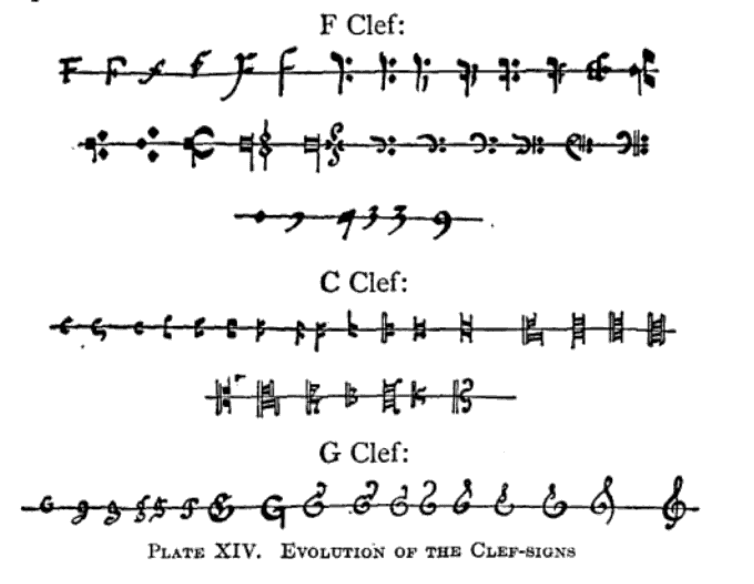
These symbols are called clefs. The name of the clef on the upper staff is the G clef. If you look closely, you can see it looks like a decorative G. This clef is often called the treble clef, which is where Treble C gets its name.
The name of the clef on the bottom staff is the F clef. This F is extremely stylized; you’ll have to use your imagination a bit more to see it. Try imagining the dots as the two horizontal lines of an upper-case F. This clef is often called the bass clef, which is where bass C gets its name.
Now that we know the names of the clefs, we can use them to learn the next set of notes.
Clef symbols are stylized letters that give you a reference note so you know which notes to play. What most people don't know is that clefs can be placed on any line or space in the staff, indicating which note is the reference note.
Of course, this changes the arrangements of notes on the staff. This sounds and is very confusing!
Fortunately for new music readers, clef placement has been standardized. G clef symbols are always placed on the second line from the bottom; this placement is called the Treble Clef. The F clef symbols are placed on the second line from the top, making the Bass Clef.
There is one other pesky clef symbol, the C clef. It's not used by many instruments today, but when it is, it's used in two different clefs: the alto clef and the tenor. It's infrequent use, and the fact that it moves makes it the bane of undergraduate music students.
I will teach you right now how to remember the difference between Alto Clef and Tenor Clef. It's so easy. But I didn't learn it until I was out of college.
Think of which choir groups sing on the Treble and Alto clefs. Altos on the alto clef (obviously) and Sopranos on the treble clef. They sing many high notes, and, as the arrows show, there's plenty of room for high notes above their clef lines.
Similarly, tenors and basses sing low notes, so plenty of room is below their clef-lines. In fact, the tenor clef has tons of room for low notes (when compared to the space that the alto clef has for high notes).
So, when trying to figure out if you're looking at a C clef and trying to figure out whether it's a tenor or alto clef, just ask yourself "Is there lots of room for low notes?" If the answer is "Yes", it's tenor clef. If the answer is "No", it's alto clef.
It's that simple. We'll learn how to read C clef later on. Like most note reading, it's simple when using the Landmark Note System.
The Clef Landmark Notes
Treble G
Once you learn this landmark note, you'll have an anchor point midway between middle C and treble C. This anchor will allow you to "pick up" in the middle of the scale and play up or down to C with ease, as well as easily play this note and its neighbor notes.
First, pick up your instrument and play these two examples again. You'll recognize them from earlier:
Both these notes end on the note G called Treble G. Here is how it looks.
Let's play through a few exercises to get comfortable with this note and the notes around it.
By now, you're comfortable with the line that the G sits on, the second line up from the bottom of the G clef. Now, take your finger and trace that line left until you reach the treble clef.
As you can see, the line that Treble G is on intersects with the G clef in such a way that it forms a "cross-hair." You can use this crosshairs as a memory aid to help you remember the location of Treble G. And, best of all, the memory aid is printed in all your sheet music!
Here is one last example to help you memorize the Treble G Landmark Note
Next, we'll move on to learning the Landmark Note Bass F.
Bass F
Now it's time to learn the midway point between Bass C and Middle C. In the bass clef, this note is called Bass F. Just like Treble G does, Bass F will give you an anchor that you can use to play up, down, and adjacent notes from.
As before, these notes fall outside of the range of our C major scale, so, for these exercises, you'll name the pitches without playing. Just like we did for Treble G, let's use some familiar exercises to introduce Bass F.
And here is Bass F all on it"s own.
Now you can read some exercises that are centered around bass F
By now, you're familiar with the line that Bass F sits on. Let's do the same thing we did with Treble G: trace the line left until you reach the clef.
Here is another memory aid to help us remember notes: The F-line is centered between the two dots of the F clef
Now that we have our core group of Landmark Notes, we're finally ready to see how knowing Landmark Notes unlocks neighbor notes all over the staff.
Revealing The Power of Using The Landmark Note System
By now, you've played and spoken note names up and down both the bass and treble clefs. You've learned the five core Landmark Notes. You've read up, down, and around these notes. Now, let's take a look at what you've actually accomplished.
The following example isn't for you to play or say. All I want you to do is look it over and find which notes aren't included.
Those staves are full of notes. And that's a good thing. What you just looked at is all the Landmark Notes and all of their neighbor notes. These are all the notes you can quickly name and play early on when you use the Landmark Note System.
Next, I want to teach you a powerful tool to help you keep the Landmark Notes memorized by showing you their symmetrical placement on the staff.
Symmetry in the Landmark Note System
Knowing the symmetrical nature of Landmark Notes will help you remember them. Applying the symmetry to all future Landmark notes will double the number of notes you can read with minimal additional effort.
By now, you've probably noticed that each pair of Landmark Notes I've introduced looks similar. That's because all Landmark Notes are symmetrical, with middle C being the center point. You can see that very clearly here. Both Treble and Bass C are the same distance from Middle C and the same distance from the outer edge of the staff.
Let's look at how symmetry works for Landmark Notes.
- C Notes are always symmetrical with C Notes.
- For G and F, symmetry only applies when the note matches the clef.
- G on the G clef = F on the F clef
- G on the F clef, F on the G clef: Does not apply
This symmetry is the reason Landmark Notes are so powerful: learning one note immediately helps you locate its partner without any extra memorization.
In the next section, we’ll use this symmetry to learn the final two Landmark Notes in this article.
Finishing with The Last Landmark Notes
Now that we know that Landmark Notes are all symmetrical to one another, we can use this to learn the last two Landmark Notes simultaneously. Once you finish this section, you'll have read every note on the treble and bass clef, plus a few notes that use ledger lines.
Both of these notes are outside the range of our C major scale, so these exercises will only involve saying the note names. Since we've learned about the symmetrical nature of Landmark Notes, I'm going to introduce both of these notes simultaneously. Both notes are on the outside edges of their staffs.
The new notes are called High G and Low F. They both lie on the outer edge of the treble and bass clef, respectively. You don't have to memorize both of these; once you locate one, you can use symmetry to tell you where the next one is.
Say the note names in the following exercises to learn the notes around High G.
And here are exercises for Low F.
Now that you know all the notes on the staff, use the exercises below to help lock in your knowledge.
Practice Note Reading Exercises
Calculate your answer, then click "Answer" to reveal the answer.
B
F
D
G
D
A
You Can Now Read Notes On The Staff
At this point, you can identify every note on the treble and bass staff without relying on Every Good Boy Does Fine or FACE. More importantly, you now have a reliable way to figure out notes when you don’t recognize them immediately.
Reading music doesn’t mean knowing every note at a glance. It means knowing where to look, what to anchor to, and how notes relate to one another. That’s what the Landmark Note system gives you.
Don’t worry if your reading still feels slow. Speed comes from repeated exposure and practice, not from memorizing more information. Each time you read, the Landmark Notes will become easier to spot, and the notes around them will start to feel obvious.
From here on out, whenever you open a piece of music, start by finding the Landmark Notes and see how everything else connects to them.
I really loved this page, and will go back to it again and again until I have mastered reading music. When I was young I remember thinking that reading music was a cinch, and when I tried again now (about 40 years later) it all seemed Greek to me. Until I came across the landmark method. I think I must have learned the landmark method as a child. Anyway, thanks. I am relearning the basics, and loving it, and your page makes it so much easier.
Thanks! I’m glad you found it useful. I didn’t learn this until after I had a degree in music, and it definitely made the bass and C clefs so much easier for me to read (I don’t use them very often as a guitarist).
I was looking for a different method to teach my teenage daughter the notes (the classic way did not work for her) and she already said your explanation was genius. So a big thank you from Romania. I wrote this comment a while back but I must have forgotten to post it.
Thanks, Gloria! Glad it worked for your daughter.
Thank you! I will use this method to teach my teenage daughter. She struggled with the classic way.
You are an absolute saint for writing/coding this. I really disliked the “every good boy” method since you need to learn 4 different mnemonics for the grand staff. And instead tried to brute force memorize the notes which didnt work, then messed around with the symmetry, but couldnt reach a system that is as clear, concise, and musical as the one you reveal here.
TYSM!!!
Thanks! Glad you found it useful. Yea, the Every Good Boy is pretty terrible when you get down to it. And brute force… well, it’s all in the name, isn’t it. I actually used a combination of Chat GPT and banging my head against the wall to code the animations here (and in my post on accidentals)
Was all worth it, they came out really clean 😉
Thank you Kale. Your teachings are very much appreciated. I will try it out today when I practice the piano 🙂
Thanks! Let me know how it goes.
This article is really useful. I tried learning with face and egbdf and like you say it’s really annoying trying to count it on the staff. The landmarks are much more intuitive – thank you.
Cool! Glad you like it; I put a lot of effort into this.
When I learned this method, I’d been playing for 20 yrs and I still found it incredibly useful (mainly for playing clefs which I don’t have much practice with).
This is awesome- thank you!!! And yes, anything you want to write about note reading (or anything else) is greatly appreciated!
Thanks, glad you like it.
What a cool system! I may finally be able to learn bass clef 🙂
Yes! And all the C-clefs, too!